
Short answer: You can recognise good olive oil by six signs: (1) the words “extra virgin” on the label, (2) a stated harvest year, (3) a specific region of origin instead of a mix of countries, (4) dark glass or tin packaging, (5) a mild, fruity taste with a light bitterness and a peppery finish, (6) a single olive variety instead of a blend. Price alone tells you little. Freshness, origin and care matter far more.
We all stand in front of the olive oil shelf in the supermarket feeling a little lost sometimes. Thirty bottles. Different prices. They all say something about “cold-pressed”, “Mediterranean” or “extra”. Which one do you take?
Most of us reach for the mid-price range, the safe middle ground. But honestly, price alone says little about whether an olive oil is really good. There are other signs. And knowing them makes all the difference to what ends up on your plate.
1. Extra virgin, and genuinely so
The first and most important criterion is on the label: under EU law, only “extra virgin olive oil” is the highest quality grade. It must be obtained by mechanical means, have a flawless taste and contain no more than 0.8 percent free fatty acids (EU Regulation No. 1348/2013).
“Virgin olive oil”, “pure olive oil” or simply “olive oil” are other, lower categories. They can be refined, heated or blended.
2. The harvest year on the label
Olive oil is not wine: it doesn't get better with age. Its aromas fade over time. A good olive oil shows you its harvest year. A poor one hides it behind a best-before date.
Rule of thumb: buy olive oil from the current or the most recent harvest.
3. A clear origin, not a mix of countries
“EU olive oil” or “blend of olive oils from EU and non-EU countries” is something you often see on cheap bottles. It means oils from different countries, different harvests and sometimes different quality grades are mixed together. That works for a cheap bottle. For reliable quality, it is less suitable.
Better: a specific origin. One region, one olive variety, one harvest year. What experts call “a single variety from a single origin”. The International Olive Council (IOC) recommends exactly this transparency as a sign of quality.
4. A dark bottle: light is the enemy
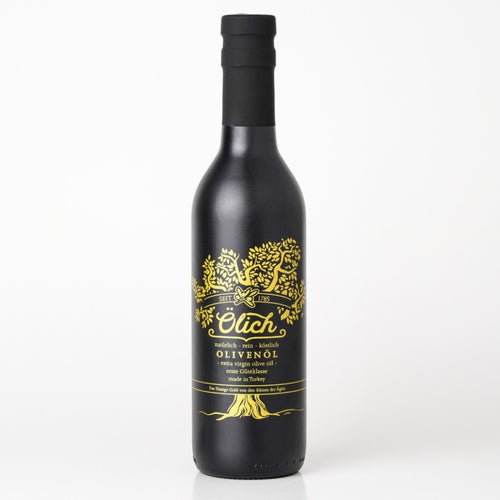
Light speeds up the oxidation of olive oil considerably. UV light passes through clear glass and plastic and breaks down aromas. A dark glass bottle or a tin protects the oil from light and keeps its aroma and freshness, the things you paid for.
A small tip: the same applies at home. Olive oil doesn't belong next to the cooker but in a cool, dark cupboard.
5. Mild, with a peppery finish
A good olive oil has character. Many good oils taste mild and fruity at first, followed by a light bitterness and a fine peppery finish that can briefly tickle the throat. That finish comes from the natural polyphenols in fresh olives.
An oil with no taste at all is often old or heavily processed. Taste for yourself and see what you notice.
6. Single variety rather than a blend
A single olive variety, such as the Memecik olive from the Edremit region on the Turkish Aegean, gives an oil a distinctive, reliable flavour. A blend of many varieties can be good, but it is harder to judge and often designed for uniformity rather than quality.
What it all means
You don't need to become an olive oil expert. But if you ask yourself three questions next time you buy: Does it say “extra virgin”? Is there a harvest year? Does it come from a specific region? Then you are already doing better than most shoppers in the supermarket.
At oelich.com we show you openly where our oil comes from and when it was harvested. Not because we have to, but because we think you should know.
Sources: EU Regulation No. 1348/2013. · IOC Trade Standard, COI/T.15/NC No 3/Rev. 14, 2019.